

Best Puppy Food for Small Breeds vs. Large Breeds

Best Puppy Food for Small Breeds vs. Large Breeds
Not all puppy food is created equal, and the size of your dog has a lot to do with why. Many formulas are specifically designed for either small breeds or large breeds, and that distinction is not just clever marketing. Puppies of different sizes have genuinely different nutritional needs, and feeding the wrong formula can have real consequences for their development, joint health, and long-term wellbeing. Whether you just brought home a Chihuahua or a Great Dane puppy, here's what you need to know to choose the right food for your new pup.

Why Is Puppy Food Different From Adult Dog Food?
Puppies grow fast. Depending on the breed, a dog can reach its adult weight anywhere from 9 months to 2 years, and during that growth period their bodies have nutritional demands that are very different from an adult dog. Puppy food is formulated with higher protein levels to support muscle development, more calories per cup to fuel rapid growth, and elevated calcium and phosphorus levels to build strong bones and teeth. Feeding an adult formula to a growing puppy means they are likely not getting the concentrated nutrition they need during the most critical developmental window of their lives.
Small Breed Puppies: What to Look For
Small breed puppies have faster metabolisms than large breeds, which means they burn through calories more quickly and can be prone to hypoglycemia (low blood sugar) if they go too long without eating. A good small breed puppy food is calorie-dense to meet those higher energy demands in a smaller portion size, and is formulated to support the faster metabolic rate of a compact dog.
Kibble size matters too. Small breed formulas use smaller, appropriately sized pieces that are easier for small mouths and teeth to chew. Standard-sized kibble isn't just awkward for a tiny puppy. Tt can be a choking risk and makes it harder for them to eat comfortably. Look for foods that specifically state they are formulated for small or toy breeds, with protein listed as the first ingredient and fat levels sufficient to support their energy needs.
Large Breed Puppies: What to Look For
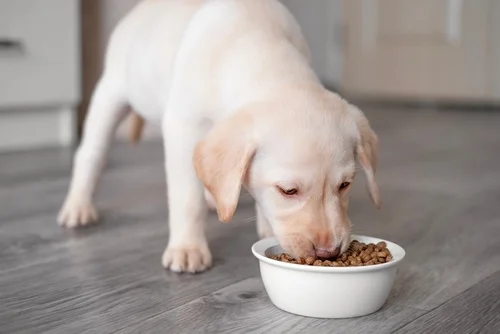
Large and giant breed puppies are in a completely different nutritional situation. Their risk is not low blood sugar, it's growing too fast. Overfeeding a large breed puppy, or feeding them a formula too high in calcium and calories, can cause bones and joints to develop abnormally fast, leading to conditions like hip dysplasia, osteochondrosis, and other orthopedic problems that can affect a dog for life. This is one of the most important things large breed puppy owners can get right.
A proper large breed puppy food is specifically formulated to support controlled, steady growth rather than rapid growth. Look for formulas that list controlled calcium levels, usually between 1.0 and 1.8 percent on a dry matter basis, and are labeled specifically for large or giant breed puppies. The protein should still be high and from quality sources, but the calorie density should be moderate rather than maximized. Portion control matters too: always follow the feeding guidelines on the package and adjust based on your puppy's body condition rather than appetite.
Key Nutrients to Look For In Any Puppy Food
DHA is an omega-3 fatty acid found in fish oil and is essential for healthy brain and eye development in puppies. The best puppy foods include a documented source of DHA. Look for fish oil, salmon oil, or fish meal listed in the ingredients. Protein quality matters more than quantity: a food with a named animal protein like chicken, turkey, salmon, or lamb as the first ingredient is a better choice than one where a protein source is listed much further down the list. Antioxidants from fruits and vegetables support immune system development in young dogs, and are a good sign that a formula is well-rounded rather than minimally formulated.
Wet Food, Dry Food, Or A Mix?
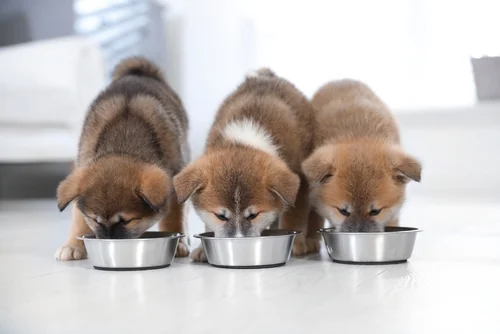
Dry kibble is the most practical choice for most puppy owners, it supports dental health, is easy to store, and keeps well throughout the day. Wet food is more palatable for picky eaters and has a higher moisture content, which supports hydration. A combination of the two is a popular approach: the majority of the diet as dry kibble, with a small amount of wet food mixed in for palatability and moisture. If you go this route, make sure both formulas are appropriate for your puppy's size and life stage, and adjust total portions accordingly to avoid overfeeding.
When to Transition From Puppy Food to Adult Food
The transition timing depends entirely on breed size. Small breeds typically reach their adult size between 9 and 12 months and can transition to adult food around that time. Large breeds take longer. Most should stay on a large breed puppy formula until 12 to 18 months, and giant breeds like Great Danes and Saint Bernards may need puppy food until 18 to 24 months. Transitioning too early cuts short the nutritional support your dog needs during their growth phase. When you do transition, do it gradually over 7 to 10 days by mixing increasing amounts of the new food with the old to avoid digestive upset.